
Know where your vehicle is
Vehicle tracking in Croatia and across Europe, from the same app where you keep your documents and costs.
Location in real time
Where the vehicle is now, without calling whoever is driving it.
Route history
A record of routes taken, useful for working out costs too.
Peace of mind
When you lend the vehicle or leave it somewhere for a while, you know where it is.
Several vehicles at once
Family or company vehicles on the same map.
Safety for young drivers
When the car is driven by someone who has just started, speed says more than location. Speed is visible today; alerts for going over a limit are in progress.
What it looks like in the app
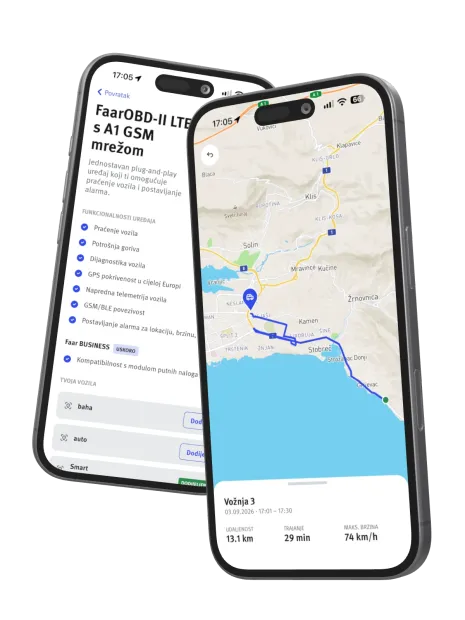
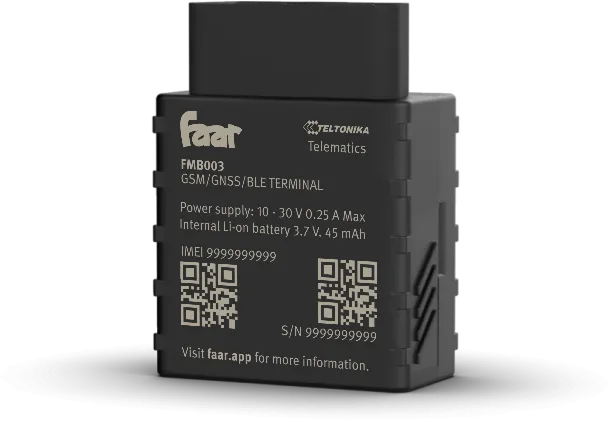
FaarOBD goes into the OBD port and is assigned to a vehicle. No fitting and no wiring.
The device reads the car: fuel, mileage, temperatures and fault codes.
Every drive records itself, with its duration, distance and top speed.
A single drive opens on the map, with the route the vehicle took.
Speed, not location
When a parent hands the car to a young driver, the question is usually not where the car is - it is whether it is being driven sensibly. So the emphasis is on speed: it is something you can have a conversation about, and it is what actually reflects safety.
A map shows where a vehicle has been, and that slides easily into surveillance. Speed is narrower and fairer: it does not reveal where someone went or who with, only how they drove.
Tracking works when it is agreed. A young driver should know the device is in the car - an arrangement both sides understand is worth more than data gathered behind someone’s back.
Frequently asked
Does it need a special device?
Tracking relies on a device in the vehicle, paired with that vehicle in Faar.
Who can see my vehicle location?
You, and anyone you have given access to. The location is not public.
Can I track several vehicles at once?
You can. Vehicles from your garage appear on the same map.
Is this surveillance of a young driver?
It depends how it is used, which is why the emphasis is on speed rather than location. Speed reflects safety without revealing where someone went or who with. We would encourage telling the young driver the device is there - an arrangement works better than monitoring.
Are there alerts for going over a speed limit?
Speed itself is visible today. Alerts that notify you on their own are in progress.
Related features
Vehicle profile
Enter the registration plate and Faar pulls in the make, model, year and engine power. Nothing to copy off your registration document.
Shared drivers
When a vehicle is shared with a partner or across a family, the reminders and the costs are shared too - and nobody hands over a password.
Service history
Every service, repair and maintenance cost is recorded against the vehicle - with the date, the mileage and the amount.
Get Faar for free
No subscription, no hidden costs. Set up your vehicle in a couple of minutes.
Get the app